

3.0 Methodology
3.1 Safety inspection procedures
Highway infrastructure safety inspections (hereinafter known as ‘safety inspections’) will be undertaken on foot or by slow moving vehicle.
Driven inspections will be carried out by two operatives (a driver plus a highways officer) in a clearly marked vehicle (high visibility markings and warning beacons) and at a speed suitable for the category of road:
- urban areas – maximum 20mph (dependent upon site conditions)
- rural areas – maximum 30mph (dependent upon site conditions)
Driven inspections are carried out in both directions.
Walked inspections will be carried out by an individual highways officer.
When carrying out walked inspections the highways officer is required to walk all footways and identify defects over the whole highway (where practicable). Further passes may be necessary for wide areas of footway used by pedestrians, e.g. shopping precincts.
The inspection will include ‘no defect’ returns where appropriate and may contain a recommendation to review the hierarchy should the highways officer have noted a change in circumstance on the route, e.g. opening/closing of school, shops, etc.
When a particular road or section of road is found to be obstructed at the time of inspection e.g. by utilities works or parked vehicles, a note recording the nature of the obstruction(s) must be made on the inspection report.
All precautions must be taken to ensure inspections are carried out as safely as possible. If a highways officer considers it unsafe to carry out a particular inspection they are to consult with their supervisor before proceeding.
Additional, reactive safety inspections outside the planned inspection regime may be necessary in response to complaints or reports of defects received from other officers, the Police, Councillors, outside organisations or the public. They may also be required as a result of incidents or extreme weather conditions or in the light of monitoring information. Inspections undertaken as a result of this type of request will be carried out by highways officers.
If, during the course of an inspection, a highways officer considers there is potential for a hazard to develop with an item of highway infrastructure they are to report it as soon as possible to the appropriate council department for further investigation.
Highway Infrastructure Safety Inspection Regime: Procedures
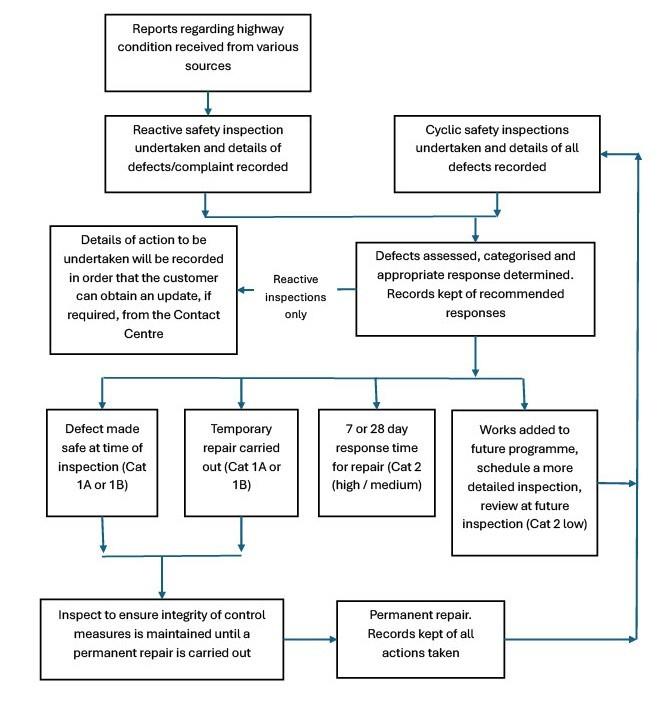
3.2 Network hierarchies
The network hierarchy is based on asset function and is the foundation of the Council’s risk-based highway maintenance strategy.
It is important that the hierarchy adopted reflects the whole highway network and the needs, priorities and actual use of each infrastructure asset. These may be determined by traffic volume or by local social and economic importance and may also be influenced by factors such as pedestrian or cyclist usage. Indeed, footway priorities may differ with carriageway priorities hence it is necessary to define separate footway and cycleway hierarchies.
It is important to consider the hierarchy of neighbouring authorities for both locally and nationally maintained networks as users will expect reasonable continuity of levels of service and collaboration in developing the network hierarchy can contribute to achieving this.
Hierarchies should be dynamic and regularly reviewed to reflect changes in network characteristics and functionality so that maintenance strategy reflects the current situation, rather than the use expected when the hierarchy was originally defined.
The network hierarchy is sub-divided into three categories to cover carriageways, footways and cycleways:
Frequency of Safety Inspections
Carriageways
|
Category |
Hierarchy description |
General description |
Frequency |
|---|---|---|---|
|
2 |
Strategic routes
|
Non Motorway Trunk and some principal "A" roads between primary destinations |
6 months |
|
3a |
Main distributor |
Major Urban Network and Inter-Primary Links. Short — medium distance traffic |
6 months |
|
3b |
Secondary distributor |
Classified Road (B & C class) and unclassified urban bus routes carrying local traffic with frontage access and frequent junctions. |
6 months |
|
4a |
Link road |
Roads linking between Main and Secondary Distributor Network with frontage access and frequent junctions. |
6 months |
|
4b |
Local access road |
Roads serving limited number of properties carrying only access traffic. (Cul de sac) |
6 months |
Footways
|
Category |
Hierarchy description |
General description |
Frequency |
|---|---|---|---|
|
1a |
Prestige zone walking
|
Prestige Areas in towns and cities with exceptionally high usage, such as Prince's Street, Edinburgh. |
1 month |
|
1 |
Primary walking route |
Busy urban shopping and business areas, and main pedestrian routes linking interchanges between different modes of transport, such as railways and bus stops etc. |
1 month |
|
2 |
Secondary walking route |
Medium usage routes through local areas feeding primary routes, local shopping centres, large schools and industrial centres |
3 months |
|
3 |
Link footway |
Linking local access footways through urban areas and busy rural footways. To Include flagged Local Access Footways. |
6 months |
|
4 |
Local access footway |
Footways associated with low usage, short estate roads to the main routes and ads de |
6 months |
Cycleways
|
Category |
Hierarchy description |
General description |
Frequency |
|---|---|---|---|
|
A |
Cycle lane
|
Cycle lane, forming part of the carriageway, commonly 1.5 metre strip adjacent to the nearside kerb. Cycle gaps at road closure point (exemptions for cycle access). |
As for appropriate carriageway category |
|
B |
Cycle track |
Shared cycle/pedestrian paths, either segregated by a white line or other physical segregation, or unsegregated. |
As for appropriate footway category |
|
Cycle track, a route for cyclists not contiguous with the public footway or carriageway. (e.g. Public Bridleway) |
1 Year or as and when required |
||
|
C |
Cycle trail |
Cycle trails, leisure routes through open spaces. These are not necessarily the responsibility of the highway authority. (e.g. Permissive Bridleway) |
1 Year or as and when required |
Safety inspections are carried out to the frequencies in the above tables and on an ad-hoc basis following complaints or reports of defects received from council officers, Councillors, outside organisations or the public.
If a footway adjacent to a carriageway has a higher frequency of inspection than the carriageway, that section of carriageway will be inspected at the same frequency as the footway as walked safety inspections include the assessment of the whole highway where practicable.
Frequencies for safety inspections are based upon consideration of:
- category within the network hierarchy;
- type of asset, e.g. carriageway, footway, cycleway;
- use, characteristics and trends;
- critical assets;
- consequence of failure;
- network resilience;
- incident and inspection history;
- Section 58 defence repudiation rates;
- resources available;
- characteristics of adjoining networks elements; and
- the approach of adjoining Highway Authorities.
3.4 Items for inspection
The following schedule contains examples of elements to be inspected when undertaking safety inspections:
Carriageways and Cycleways
- carriageway running surface (including cycleways that form part of the carriageway)
- cycleway running surface (if not part of the carriageway)
- channels
- kerbs
- pedestrian crossings
- traffic islands
- central reservations
- crossovers (central reservation gaps)
- hard shoulders
- lay-bys
Footways and Combined Cycleways
- footway or combined footway/cycleway running surface
- kerbs
- edgings
- channels
- verges
Ironwork
- gullies and frames
- manhole/catchpit covers and frames
- utilities covers and frames
- kerb outlets
Drainage
- gullies
- grips
- highway ditches
Road markings
- Stop lines
- Give Way markings
- continuous centre lines
- edge lines
- other road markings
Road studs
- depressible reflective road studs (Halifax style cats eyes or similar)
- non-depressible reflective road studs
- non-reflective road studs (zebra and pelican crossings)
Lighting, signs, bollards, traffic signals
- lighting columns
- illuminated signs and mounting poles
- illuminated bollards
- traffic signal installations
- temporary traffic signals
- pedestrian crossing signals
- wall mounted street lighting
- all other lighting units
Non-illuminated signs and bollards
- non-illuminated signs and mounting poles
- bollards
Safety fencing, guardrails, handrails
- safety fencing
- pedestrian guardrails
- parapet walls
- handrails
- fences and barriers
- boundary walls and fences
Trees, hedges, shrubs, noxious weeds
- trees
- hedges
- shrubs and other vegetation
- noxious weeds
Bridges, embankments, cuttings, retaining walls
- Bridges
- Embankments
- Cuttings
- Retaining Walls
Highways general
- scavenging - the full extent of the highway
- temporary roadworks
- bus shelters
- street nameplates
- all items of street furniture not covered elsewhere
Guidance Notes on Items for Inspection
Ironwork:
This may necessitate repairs to, and the occasional replacement of, the different types of gratings, covers, frames and boxes that are the direct responsibility of the highway authority. It may be necessary on occasions to repair or replace items that are the responsibility of other parties if it is deemed there is a hazard to road users or pedestrians. The defects will be made safe and all costs incurred recovered from the other parties.
The majority of covers, gratings and frames are situated in carriageways and footways but those in verges, particularly those verges that are regularly used by pedestrians or horses, should not be ignored and any defects should be risk assessed appropriately. It may be difficult to decide whether a cracked or broken item is in real danger of collapse but if in doubt it should be replaced irrespective of its position.
Defects in covers and gratings may pose particular danger to pedal and motor cycle users. It should be remembered that they will not always confine their riding zone to the nearside edge of the carriageway.
Public utilities covers/apparatus:
Procedures have been agreed through the Highway Authorities & Utilities Committee (HAUC) and a process exists to deal with reports or findings of utility apparatus that is considered to be dangerous. The procedure entails the highway authority notifying the details and location of the defective apparatus following which the utility company will acknowledge receipt (or refute responsibility if not their apparatus) within an agreed timescale and confirm actions taken to make safe the apparatus to the satisfaction of the highway authority. Failure of this procedure in any way by the utility company will result in the highway authority acting in default and making safe the location on a rechargeable basis.
Trees, hedges, shrubs, noxious weeds:
The trees, hedges and shrubs referred to are those in the ownership of the highway authority together with those that are the responsibility of private landowners but which potentially affect users of the highway.
If a tree, hedge or shrub is council owned then the problem should be reported to the council’s Horticultural Team. If the tree, hedge or shrub is privately owned then the landowner should be requested to carry out all necessary remedial works and informed that if they do not comply within a reasonable time period they may be served notice under Section 154 of the Highways Act 1980 and any costs incurred by the council in carrying out the works shall be recharged to them accordingly.
Any damage to carriageways and/or footways which is suspected of being caused by tree roots should be assessed to determine if it needs to be referred to the Arboricultural section for further advice. If the area of the defect is minor and there are no signs of previous repair then appropriate remedial works should be carried out and a note made to monitor the repair at future inspections. If the area around the defect has previously been repaired or the area and severity of the defect is extensive then consultation with the Arboricultural section should be sought in order to determine a long term solution to the problem, though a temporary repair may be necessary in the interim.
If it is suspected that a tree or its root system has been damaged by a third party e.g. a utility company, then this will be reported for further inspection. This may lead to a possible action to claim compensation for unauthorised or avoidable damage to the tree.
In all cases, whenever a highways officer is unsure of what action to take with regards to a problem concerning trees, hedges, shrubs or noxious weeds then the appropriate council department should be contacted for further advice.
Highways general:
Bus shelters that are found to be damaged or vandalised shall be reported to the council’s Traffic team in the first instance who will then notify the appropriate owner. Privately owned bus shelters (Clear Channel) have a reference number on the shelter and this should be recorded and included in the report. Any broken glass must also be notified to the council’s Traffic team for immediate removal by the appropriate bus shelter owner. Any damage to or failure of electrical equipment in council owned bus shelters should be reported to the Street Lighting section and any damage to or failure of electrical equipment in privately owned bus shelters should be reported to the appropriate bus shelter owner.
Items of street furniture found to be damaged or vandalised shall be reported to the council’s Highways Infrastructure team for repair or replacement.
3.4 Items for inspection
The investigatory levels for defects arising from safety inspections are shown in the following table:
Carriageway
(including Category 1 cycleways)
|
Defect |
Investigatory level |
|---|---|
|
Pothole, Spalling |
≥40mm depth ( ≥300mm wide in any horizontal direction) |
|
Settled trench: with the flow of traffic |
≥40mm depth |
|
Settled trench: 90o to the flow of traffic |
≥40mm depth |
|
Depression |
≥40mm depth |
|
Rutting |
≥25mm depth |
|
Crowning |
≥40mm difference in level |
|
Surface cracking |
≥20mm wide |
|
Tree root damage |
≥40mm difference in level |
|
Gap around ironwork |
≥25mm (W) x 40mm (D) x 100mm (L) |
|
Sunken/protruding/rocking ironwork |
≥40mm difference in level |
|
Misaligned/loose/rocking channel blocks |
≥40mm vertical movement |
|
Loss of skid resistance (affected length to be reported to Highway Network & Flood Risk Management for further action) |
Report |
Pedestrian crossing
(this includes all uncontrolled designated crossing points)
|
Defect |
Investigatory level |
|---|---|
|
Trip/Pothole |
≥20mm depth |
Footway
(including Category 2 cycleways)
|
Defect |
Investigatory level |
|---|---|
|
Trip, Pothole |
≥20mm depth |
|
Rocking paving flag/block |
≥20mm vertical movement |
|
Open joint/surface cracking |
≥25mm (W) x 20mm (D) |
|
Surface cracking in Cat 2 cycleways |
≥20mm wide |
|
Settled trench: any direction |
≥20mm depth |
|
Crowning |
≥20mm difference in level |
|
Depression |
≥20mm depth |
|
Tree root damage |
≥20mm difference in level |
|
Misaligned/ loose/rocking edging |
≥20mm vertical movement |
|
Gap around ironwork |
≥25mm (W) x 20mm (D) x 100mm (L) |
|
Sunken/protruding/rocking ironwork |
≥20mm difference in level |
Kerbing
|
Defect |
Investigatory level |
|---|---|
|
Misaligned/loose/rocking (adjacent to footway) |
≥50mm horizontally and/or 20mm vertically |
|
Misaligned/loose/rocking (not adjacent to footway) |
≥50mm horizontally and/or 40mm vertically |
|
Missing, badly eroded |
Action for repair/replacement if necessary |
|
Defect |
Investigatory level |
|---|---|
|
Pothole, Spalling |
≥20mm depth |
|
Settled trench, Depression |
≥20mm depth |
|
Surface cracking |
≥25mm (W) x 20mm (D) |
|
Crowning, Tree root damage |
≥20mm difference in level |
|
Gap around ironwork |
≥25mm (W) x 20mm (D) x 100mm (L) |
|
Sunken/protruding/rocking ironwork |
≥20mm difference in level |
|
Defect |
Investigatory level |
|---|---|
|
Verge damage caused by unauthorised vehicular parking/overriding adjacent to and running parallel with carriageway edge (urban and rural) |
≥200mm depth
|
|
Verge damage caused by unauthorised vehicular parking/overriding adjacent to and running parallel with footway edge (urban) |
≥100mm depth
|
|
Verge damage caused by unauthorised vehicular parking/overriding adjacent to and running parallel with footway edge (rural) |
≥150mm depth
|
|
Sunken/protruding/rocking ironwork |
≥20mm difference in level |
|
Obstruction, restricted sightlines |
Report |
Ironwork
|
Defect |
Investigatory level |
|---|---|
|
Gaps within framework (other than designed by manufacturer) |
≥20mm wide
|
|
Level differences within framework
|
Refer to relevant defect within the carriageway, footway and verge items |
|
Rocking covers and grates
|
Refer to relevant defect within the carriageway, footway and verge items |
|
Missing covers and grates |
Report |
|
Cracked / broken covers and grates |
Report |
|
Worn / polished covers and grates |
Report |
Flooding
|
Defect |
Investigatory level |
|---|---|
|
Standing water likely to cause a hazard |
Report |
|
Substantial discharge of water across carriageway |
Report |
|
Substantial discharge of water across footway |
Report |
|
Water running into property |
Report |
Drainage
|
Defect |
Investigatory level |
|---|---|
|
Blocked gully (silted above outlet) |
Report |
|
Blocked grips, highway ditches |
Report |
|
Collapsed / blocked / settled items or systems |
Report |
Road markings
|
Defect |
Investigatory level |
|---|---|
|
Faded or worn markings (particularly Stop, Give Way, continuous centre and edge lines) |
≥30% loss of markings or where a considered risk/hazard is seen to exist
|
Road studs, cats eyes
|
Defect |
Investigatory level |
|---|---|
|
Missing |
Report |
|
Displaced item on c/way |
Remove and Report |
|
Void left in c/way |
≥40mm depth |
|
Defective item |
Report |
Lighting columns, illuminated signs and bollards, traffic signals, signal controlled pedestrian crossings
|
Defect |
Investigatory level |
|---|---|
|
Exposed electrical wiring |
Report |
|
Missing door to lighting column |
Report |
|
Damaged/misaligned/missing items liable to cause a hazard |
Report |
|
Leaning lighting column |
Report |
|
Rust holes developing in column |
Report |
|
Installations obscured by tree branches/foliage/overgrown shrubs |
Report |
|
Day burners |
Report |
|
Traffic signals or pedestrian crossing controls inactive or not operating correctly. |
Report |
|
Signal lamp blown, lens broken or street lights not working |
Report |
|
Defective lighting in bus shelters |
Report |
Traffic signs and bollards
|
Defect |
Investigatory level |
|---|---|
|
Missing post or bollard |
Report |
|
Signs slipped or erected too low
|
<2.1m over footways <2.4m over cycleways <5.1m over carriageways |
|
Damaged/misaligned/missing signs |
Report |
|
Sign illegible, faded, defaced by graffiti, vandalised |
Report |
|
Item obscured by hedges, trees, vegetation, other signs |
Report |
Safety fencing, parapet walls, pedestrian guardrail, handrails, boundary fences and walls
|
Defect |
Investigatory level |
|---|---|
|
Item damaged or misaligned causing a hazard |
Report |
|
Unstable item or section |
Report |
|
Missing panels, sections of safety fencing, handrails, walling |
Report |
Bridges, embankments, cuttings and retaining walls
|
Defect |
Investigatory level |
|---|---|
|
Structure is showing obvious visual signs of deterioration |
Report |
|
Unstable embankment, cutting or retaining wall |
Report |
Highways general
|
Defect |
Investigatory level |
|---|---|
|
Spillages/debris/mud on highway likely to cause a hazard |
Report |
|
Overhead wires damaged or unstable |
Report |
|
Street furniture missing or damaged likely to cause a hazard |
Report |
|
Sub-standard signing, coning, guarding and temporary surface ramping at roadworks sites |
Report |
|
Damaged/dislodged traffic calming humps |
Report |
|
Fly-tipping, dead animals, hypodermic syringes and needles |
Report |
|
Illegal signs, obstructions in the highway |
Report |
|
Scaffolding likely to cause a hazard |
Report |
|
Skips likely to cause a hazard |
Report |
|
Unprotected building materials on the highway |
Report |
|
Abandoned vehicles likely to cause a hazard |
Report |
Other dangers to the public
|
Defect |
Investigatory level |
|---|---|
|
Anything else considered dangerous |
Report |
With regard to defects specified in the above table, particularly those covered under the “Highways General” heading, many are the responsibility of other individuals or organisations and not the highway authority. However, the Council do have a duty of care to highway users and highways officers will make every effort to identify the third party responsible for the defect and draw their attention to both the defect and their responsibilities. If the third party is known and unwilling or unable to rectify the problem, any costs incurred by the Council in remedial action can be recharged to them accordingly
Any defect identified where the third party responsible is unknown shall be recorded and action taken to make the defect safe. Follow-up investigations shall then be undertaken to identify the responsible party.
3.5 Defect categories and response times
Safety inspections are designed to identify all defects likely to create danger or serious inconvenience to users of the network or the wider community. The risk of danger is assessed on site and the defect identified with an appropriate priority response.
These defects are sub-divided into two categories:
Category 1: those that require prompt attention because they represent an immediate or imminent hazard or because there is a risk of short-term structural deterioration.
Category 2: all other defects.
Determining whether defects should be treated as Category 1 or Category 2 and the nature and speed of response will depend, amongst other things, upon the assessed risk posed by:
- the depth, surface area or other degree of deficiency of the defect or obstruction
- the volume, characteristics and speed of vehicular traffic and the volume and characteristics of pedestrian traffic
- the location of the defect relative to highway features such as junctions and bends
- the location of the defect relative to the movement of users, especially vulnerable users, such as in traffic lanes or wheel tracks
- the nature of interaction with other defects
- forecast weather conditions, especially potential for freezing of surface water
- the possibility of legal proceedings
Category 1 defects
Category 1 defects are to be made safe or repaired within 24 hours from the time that the authority first becomes aware of the defect and some will be so serious as to require attention within 2 hours. Following temporary repair of a Category 1 defect the highways officer will risk assess the repair and place an order for a permanent repair to be completed within a 7 or 28 day period taking into account location and hierarchy.
Some defects are potentially so dangerous that immediate action is required and shall be reported to Highways Team Leader. These are defects which, due to their nature and location, represent a very serious risk to the public and they must not be left unattended unless and until adequate barriers, warning signs or cones have been put out to warn the public of the hazard.
Response times for remedial action of Category 1 defects are:
Priority 1(A): those that require a 2 hour response because they represent an immediate hazard
Priority 1(B): those that require a 24 hour response because they represent an imminent hazard
Where defects are made safe using temporary signs, barriers or cones, appropriate interim inspections should be carried out to ensure the integrity of the system is maintained until a permanent repair can be carried out.
If a Category 1 defect is identified within a larger defective area only that part of the area which meets the criteria for Category 1 defects shall be treated as such. The remainder of the area will be treated as a Category 2 defect except where this is impractical to do so.
Some Category 1 defect repairs may be due to the activities of utility companies, which are governed by the requirements of the New Roads and Street Works Act, 1991 (NRSWA). If the reinstatement is still within its guarantee period (2 years for reinstatements) and is outside its specified tolerances due to settlement, crowning, plucking out or other reasons and within Category 1 criteria, any costs incurred in making safe and/or repair must be recovered from the utility company and not charged to the highway authority. All costs must be charged in accordance with the Street Works (Recovery of Costs) (England) Regulations 2002. This is to be arranged by reporting all such defects to the HBC Street Works Officer.
Under Section 81 NRSWA, any Category 1(A) utility ironwork defects, i.e. missing covers, will be reported by the highways officer direct to the appropriate utility company to be made safe immediately. The utility company will acknowledge receipt and confirm actions to be taken to make safe the apparatus to the satisfaction of the highway authority. Failure of this procedure in any way by the utility company will result in the highway authority acting in default and making safe the location on a rechargeable basis.
Category 2 defects
Category 2 defects may have safety implications, albeit to a lesser extent than Category 1 defects, but are more likely to have serviceability or sustainability implications. Defects identified for remedial works shall have their repairs carried out within the designated response times.
Category 2 defects are categorised according to the priority high (H) or medium (M) based on the risk assessment process. Any risk identified must take into account the possibility of further deterioration before the next scheduled inspection and if this is likely then the priority of response should be increased or an intermediate special inspection programmed.
Response times for remedial action of Category 2 defects are as follows:
Priority 2(H): make safe and/or permanent repair within 7 working days
Priority 2(M): permanent repair within 28 days
If it is not possible to undertake a repair within the specified timescale then an operational officer will enter the reason for the delay on the works order at the time the works are completed.
The comments relating to utility reinstatements/apparatus and adherence to the time limits for their repair apply equally to Category 2 defects as to Category 1 defects.
3.6 Risk assessments
The principle of “Well-managed Highway Infrastructure” is that Highway Authorities will adopt a risk-based approach in accordance with local needs including safety and condition inspections and in determining repair priorities and replacement programmes. It should be undertaken against a clear and comprehensive understanding and assessment of the likelihood of asset failure and the consequences involved.
The highest profile risks affecting the highway maintenance service are those relating to the safety of the network and accident, injury or health risks to its users, including employees.
With regard to highways officers, risks to health and safety should be assessed and minimised through awareness of procedures and appropriate training (see Section 3.9).
In order to operate a successful, efficient safety inspection regime it is essential that highways officers are thoroughly trained in conducting risk assessments.
The procedure for risk assessment is as follows:
Risk identification: an inspection item for which the defect investigatory level is reached or exceeded is to be identified as a risk and treated as an actionable defect.
Note: It should be noted that there may be instances whereby the defect investigatory level is not reached or exceeded and as such no risk is identified, however, due to its location or environment the highways officer may deem it appropriate to classify this item as a defect and process the repair at an appropriate level by applying the risk assessment from first principles.
Risk evaluation: all risks identified through this process have to be evaluated in terms of their significance which means assessing the likely consequence should the risk occur and the likelihood of it actually happening.
Risk consequence: the consequences of a risk occurring should be quantified on a scale of 1 to 4 and assessed as follows:
- insignificant consequence
- minor consequence
- significant consequence
- major consequence
Consequence is quantified by assessing the extent of damage likely to be caused should the risk become an incident. As consequence is likely to rise with increasing speed, the volume of traffic and type of road are clearly important considerations in the assessment.
Risk likelihood: the likelihood of a risk occurring should also be quantified on a scale of 1 to 4 and assessed as follows:
- very unlikely
- possible
- probable
- very probable
Likelihood is quantified by assessing the probability of users passing by or over the defect and encountering the risk. As likelihood is liable to increase with a rise in vehicular or pedestrian flow, the network hierarchy and defect location are important considerations in the assessment.
Risk factor: the risk factor for a particular risk is the product of the risk consequence and risk likelihood and is therefore in the range of 1 to 16. It is this factor that identifies the overall seriousness of the risk and consequently the appropriateness of the speed of response to remedy the defect. Accordingly, the priority response time for dealing with a defect can be determined by correlation with the risk factor as shown in the risk management table.
Risk management: having identified a particular risk, assessed its likely consequence and likelihood and calculated the risk factor, the risk management procedure for determining the timescale in rectifying the defect can be shown in the form of a risk matrix as follows:
 Likelihood →
 Consequence ↓ Consequence ↓ |
Very Unlikely
(1)
|
Possible
(2)
|
Probable
(3)
|
Very Probable
(4)
|
|
Insignificant (1) |
1 |
2 |
3 |
4 |
|
Minor (2) |
2 |
4 |
6 |
8 |
|
Significant (3) |
3 |
6 |
9 |
12 |
|
Major (4) |
4 |
8 |
12 |
16 |
|
Response category |
Re-inspect at next schedule | Category 2(M) response | Category 2(H) response | Category 1 response |
As a result, the risk factor and priority response can be tabulated in a simple format as follows:
|
Risk factor |
Priority response |
|---|---|
|
16 |
1 (A) and (B) |
|
9 – 12 |
2 (H) |
|
6 – 8 |
2 (M) |
|
1 – 4 |
Next inspection schedule |
Highways officers shall have particular regard to defects in locations where vulnerable users may be expected, such as in the vicinity of hospitals, medical centres, nursing homes, aged people’s homes, schools and public buildings. Furthermore, the highways officer will have the discretion to shorten the response time for repair when it is assessed that there are particular risks for vulnerable users at that location.
The register also incorporates defects which may not be the responsibility of the highway authority such as utility trench reinstatements and ironworks, or hazards caused by third parties such as obstructions in the highway or dangerous scaffolding. Although the highways officer must ensure that all relevant information is notified either directly to the third party concerned or to the appropriate person or section responsible for dealing with the matter, they must also satisfy themselves that the authority’s obligations are fully met with respect to duty of care. If a defect is deemed sufficiently hazardous, the highways officer must ensure that the site is made safe immediately.
3.7 Recording and training
Recording
All elements of the inspection and survey regime should be applied systematically and consistently. This is particularly important in the case of network safety, where information may be crucial in respect of legal proceedings. It is important to recognise that all information recorded, even if not primarily intended for network safety purposes, may have consequential implications for safety and may therefore be relevant to legal proceedings. It is also important to recognise that records may have to be made available for public inspection and reference and so it is essential that all documents (whether electronic or paper based) are fully completed.
Recognising the potential for the inspection forms to be used as evidence in legal proceedings it is imperative that all entries made by highways officers during the course of an inspection are clear, unambiguous and all forms are fully completed.
To ensure that repairs can be efficiently carried out it is essential that the information provided by the highways officer is clear, precise and easily understood. The location, position on the highway, nature and approximate size of the defect must be recorded to allow those responsible for carrying out the repairs to be able to provide the correct materials and quickly locate the defect.
It is important that the presence of any obstacles that hamper the carrying out of an inspection, e.g. parked cars, snow or leaves obscuring part of footway/carriageway are recorded on the inspection sheet.
Training
Competence is the combination of training, skills, experience and knowledge that a person has and their ability to apply these to a set of tasks correctly and consistently. So while training and assessment are critical to improving the competence of staff, the authority is aware that staff will still have different degrees of competence, which will improve over time, given the right experience and appropriate day to day management and supervision.
Competence is especially important in the case of inspections and surveys, where the quality and treatment of data and decision making could have significant legal and financial consequences. It is therefore fundamental that highways officers understand the concepts involved and have the skills to carry out dynamic on-site risk assessments in relation to potential safety defects.
Clear guidance and training will be provided to highway officers in order to enable the establishment and practical implementation of a risk-based approach to safety inspections.
The Institute of Highway Engineers (IHE) administers the UK Highway Inspectors training and certification scheme, approved by the UK Roads Board. It established the Highway Inspectors Board and candidates who successfully complete the courses run by an approved centre are eligible for inclusion on the National Register of Highway Inspectors for a period of five years. Registration is renewable after a maximum of five years, subject to a refresher course and assessment by an approved centre.
The authority believes registration with the Highway Inspectors Board contributes positively to risk management and defence of compensation or liability cases and all highway officers will complete the Highway Safety Inspectors Training and Certification Scheme and be registered on the National Register of Highway Inspectors.
Under the provisions of the Health & Safety at Work Act and underpinning regulations, it is an important consideration that all operatives are fully conversant with procedures for safety on site both for themselves and for contractor’s personnel as well as other highway users.
The Council is fully committed to staff development and training, and insofar as the highway inspection service is concerned, appropriate training will be given to the relevant personnel involved.
Training for relevant staff will include:
- induction and briefing
- safety on site for highways officers and other highway users
- introduction to the Highway Infrastructure Safety Inspection Manual
- introduction to risk-based approach
- workshops on risk-based assessments
- insurance requirements for third party claims
- participation in mock court cases relating to highways third party claims
- introduction to arboricultural defects and recognition of noxious weeds
- any courses of relevance to highway inspections