

11.0 Life cycle planning
11.1 Introduction
Transport assets have life cycles that include the following phases:
- Creation/Acquisition
- Maintenance
- Renewal or Replacement
- Upgrading
- Disposal or Decommissioning
Consideration of each of the above phases for the Council’s transport assets will help drive a shift towards longer-term asset management and planning. Such a longer-term approach is a key element of the asset management approach.
11.2 The life cycle planning process
Detailed life cycle plans have been produced for the following transport assets:
- Carriageways
- Footways
- Cycleways
- Structures
- Drainage
- Street Lighting
- Traffic Signals & Telematics
- Public Rights of Way
- Trees, Hedges, Verges & Planted Areas
- Unlit Signs & Street Furniture
- Barriers & Safety Fences
- Road Markings & Studs
For each of these assets, the following aspects were considered in detail:
Inventory: Information detailing the extent of the asset, split into relevant groups. Includes important data deficiencies or systems issues. Based upon this data, an estimate of the value (Gross Replacement Cost) of each asset has been made.
Condition: Sets out the current condition of each asset. Details the inspection methods and survey regimes used, the data collected, where it is stored and the degree of confidence in the data. Where appropriate this section includes statements and standards that define the desired condition of the asset.
Option Appraisal: Details how options are identified and appraised for each phase of an asset’s life.
Budget Optimisation: Reviews how budgets are currently distributed between assets and the processes in place for assessing competing demands upon available budgets.
Performance Gaps: The gaps between present condition and that which is desired.
11.3 Carriageways
The main purpose of the carriageway network is to provide safe and unobstructed flow for all categories of road user.
Condition
The condition of carriageways is monitored by a number of Best Value
Performance Indicators (BVPI’s). These are:
- NI168 – Condition of Principal (‘A’) Roads
- NI169 – Condition of non-principal, classified (‘B’ and ‘C’) Roads
- BVPI 224(b) – Condition of Unclassified (‘U’) Roads (No longer reported on)
These indicators are used throughout England and enable comparisons between authorities.
Assessing Condition
Carriageway condition is assessed via a variety of methods. Condition surveys are undertaken to ascertain information on the nature and severity of carriageway deterioration in order to determine the most appropriate maintenance treatment and thereby ensure value for money.
The survey methods available in Hartlepool include:
SCANNER (Surface Condition Assessment of the National Network of Roads) Previously described as TRACS – Type Surveys (TTS). Scanner surveys are automated high speed vehicular surface condition surveys which collect the
following data: -
- Road Geometry
- Survey Speed
- Longitudinal Profile
- Wheeltrack Rutting
- Texture Profile
Cracking (both in the wheel paths and for the whole carriageway)
Coarse Visual Inspection (CVI)
Visual survey carried out from a slow moving vehicle or on foot to collect basic defects in accordance with UKPMS requirements on the highway network.
CVI surveys are carried out on all roads within the network excluding unsurfaced roads. The survey is also used to target carriageway schemes submitted for the 5-year programme.
Ground Penetrating Radar Surveys (GPRS)
SCRIM
The Sideway-force Coefficient Routine Investigation Machine (SCRIM) is used to monitor the in service skid resistance of parts of the hierarchy. Refer to Skid Resistance policy.
GRIPTESTER
The Griptester is used to measure the in service skid resistance of parts of the hierarchy. Refer to Skid Resistance policy.
Assessing Condition
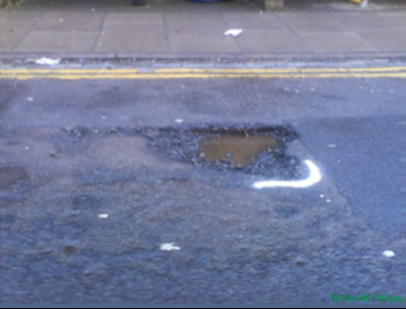
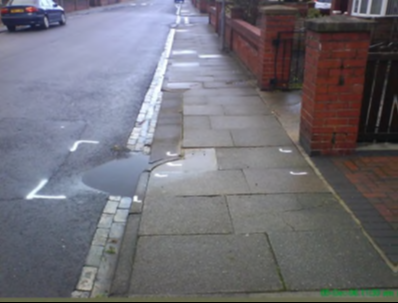
Carriageway defects
There are a number of performance measures used to assess the condition of roads. Best Value Performance Indicators (BVPI’s) enable the condition of the Council’s carriageways to be compared with those managed by other authorities. The Best Value Performance Indicators for carriageways are:
- NI168 – Condition of Principal (‘A’) Roads
- NI169 – Condition of non-principal, classified (‘B’ and ‘C’) Roads
- BVPI 224(b) – Condition of Unclassified (‘U’) Roads (No longer reported on)
These indicators are used throughout England and enable comparisons between authorities.
Each of these indicators provides a measure of the percentage of carriageways that are in need of further investigation and/or repair. Therefore the lower the figure for these indicators, the better the condition of our carriageways.
NI168 is derived from surveys of the ‘A’ road network carried out by a machine called a SCANNER. This measures a number of defects, including rutting, texture depth, cracking and ride quality.
NI169 is also derived from SCANNER surveys. However, up to year 2005/6 the condition of ‘B’ and ‘C’ roads were measured by visual surveys called Coarse Visual Inspections (CVI).
BVPI 224b is derived from CVI surveys of a minimum 25% sample of the Unclassified road network each year. From 2006/07 the length of network used to calculate the BVPI has changed. Previously, only that current year’s survey data was eligible (based on a minimum 25% network coverage per annum) but from 2006/07 the figure in Hartlepool was based on 100% network coverage. All CVI data collected since 31st March 2003 is valid but a minimum of 25% must be no older than 31st March 2006. This indicator is no longer reported.
Current Condition
Due to the changing nature of condition surveys over the years it is difficult to compare results by those which were previously measured by TRACS-TYPE / CVI surveys and the current SCANNER results.
It is hoped that the surveys for ‘A’, ‘B’ and ‘C’ roads will remain constant for the foreseeable future which will enable direct comparisons to be made over a number of years.
Unclassified roads were previously measured by CVI by taking a 25% sample rotated every four years. Since the sample of roads was different each year (in the cycle) direct comparison proved difficult, therefore, the Council has adopted the stance to survey 100% of it’s unclassified network every year to enable these comparisons to be made.
Desired Condition
Hartlepool Borough Council is striving to achieve median to top quartile performance for all classes of road, in comparison with other English Councils.
A comparative performance shows that we have to improve upon our current level of service to achieve this aim.
Option Appraisal
Creation/Acquisition
Most new carriageways are built by developers and are subject to the development control process before they are adopted by the authority as being maintainable at public expense. The development control procedure enables the Council to be sure that new carriageways have been constructed to the requisite specification. Maintenance issues are considered as part of this process, with commuted sums being charged for items that attract particularly high maintenance overheads.
Processes are in place to ensure that new carriageways are placed on the Council’s street gazetteer and are network referenced. New carriageways then become subject to the relevant inspection and cyclic maintenance regimes, as well as being integrated into the inventory data collection rolling programme.
Maintenance, Renewal or Replacement and Upgrading
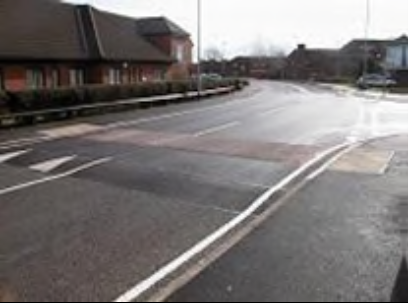
New Carriageway Surface
The maintenance treatment for carriageways may be categorised as:
- Cyclic: e.g. sweeping
- Reactive: e.g. emergency rectification of dangerous defects, removal of dangerous litter / detritus and zonal repairs arising from safety inspections.
- Planned: e.g. surface dressing, plane and inlay. These treatments are largely preventative.
Planned maintenance also includes works designed to upgrade or renew carriageways and increase their residual life. These treatments may include major structural overlays and full depth reconstruction.
Disposal or Decommissioning
In the vast majority of cases, carriageways need to last forever. The only way that a carriageway can cease to be highway is via the formal legal process called Stopping Up. It is rare for carriageways to be stopped up, therefore the duties in terms of maintaining carriageways continue to rest with the authority.
Budget Optimisation
Funding for carriageways maintenance, upgrade and renewal is split into revenue and capital.
Capital
Capital expenditure for maintenance is used to improve the life of carriageways by strengthening or replacing the asset, e.g. overlaying a carriageway surface.
Capital funding comes from central government via the Local Transport Plan (LTP) process topped up by Council borrowing. LTP funding is allocated on the basis of a split between integrated transport and maintenance, with the latter divided up between roads, bridges and lighting.
Revenue
Revenue expenditure is used for recurring routine maintenance such as patching and surface treatments.
The Council may supplement their capital allocation by using prudential borrowing. Whilst such borrowing may provide capital funds, it has associated debt charges, which have implications on the amount of revenue available for several years thereafter.
There have been successive “real term” reductions in the revenue budget and increases in the amount of uncontrollable budget, e.g. additional contributions to highways liability fund.
The decision on whether to use prudential borrowing will be influenced by the ability to meet the debt charges.
Borrowing could have two effects
- To increase the ‘gearing’ of any budgetary changes on the controllable parts of the budget and
- To increase the use of capital funding as a substitute for revenue.
Note: This can be done on repair works that have a long-lasting effect e.g. patching prior to surface dressing, and are essential to keeping the highway assets in a safe condition. This, in turn, reduces the amount of capital available for improvements to the strength and condition of the road network.
Future investment needs to maximise the life cycle of the assets and to minimise the revenue implications both in terms of works and debt charges.
Performance Gaps
One method of defining performance gaps in terms of carriageway condition is to utilise BVPI values. However, these gaps will continue to be somewhat difficult to monitor until such time as consistency in measurement of BVPI’s is achieved.
Given these caveats, some performance gaps can be determined through comparison between current condition of carriageways and the desired condition.
Similarly, performance gaps can be determined in terms of Hartlepool’s position relative to other authorities and its desired position in terms of carriageway condition based BVPI’s.
11.4 Footways
Footways are located beside carriageways to provide safe and unobstructed access for pedestrians. These also include the access links between footways on separate carriageways.
Condition
Assessing Condition
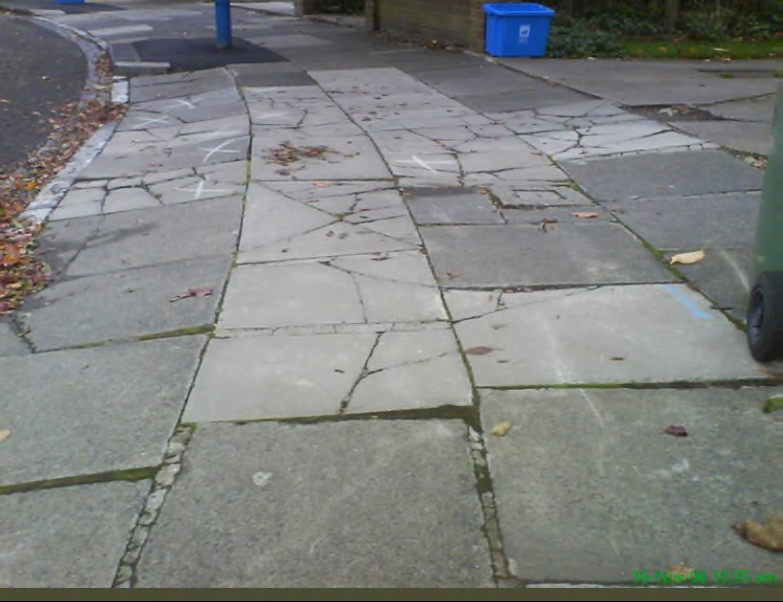
Footway defects
The condition of busier footways (hierarchies 1, 1a and 2) were previously assessed via Detailed Visual Inspection (DVI) which is a walked, visual survey that records the condition of the footway. One hundred percent of these footways were surveyed each year.
This DVI data was used to produce BVPI 187 which is the percentage of category 1, 1a and 2 footways in need of further investigation and/or repair.
However from 2011/12 the council ceased collecting this data specific to BVPI 187 and instead utilises the safety inspection results obtained via the Councils team of highway inspectors. The Council inspects all footways for defects, with the frequency of inspections dependent on footway hierarchy. These inspections enable the recording of dangerous defects, which are then scheduled for repair.
Desired Condition
The optimum condition of the Council’s footways from an engineering and minimum whole life cost perspective would be to achieve a steady state situation based upon timely intervention.
The authority is committed to improving the condition of the Council’s footways.
Option Appraisal
Creation/Acquisition
Many new footways are built by developers and are subject to the development control process before they are adopted by the authority as being maintainable at public expense through the relevant sections of the Highways Act 1980. The development control procedure enables the council to be sure that new footways have been constructed to the requisite specification.
New footways may be requested by Councillors, residents, and other bodies such as Parish Councils.
Maintenance, Renewal or Replacement and Upgrading
The maintenance treatments for footways may be categorised as
- Cyclic: e.g. sweeping and weed control
- Reactive: e.g. rectification of dangerous and patching, edgings
- Planned: e.g. slurry sealing and resurfacing. These treatments are largely preventative.
Planned maintenance also includes works designed to upgrade or renew footways to their original design lives. These treatments may include replacement of flagged and concrete footways with bituminous materials.
Disposal or Decommissioning
In the vast majority of cases, footways need to last forever. The only way that a footway can cease to be highway is via the formal legal process called ‘Stopping Up’. It is very rare for footways to be stopped up other than those associated with new developments. Therefore the duties in terms of maintaining footways continue to rest with the authority.
Budget Optimisation
Revenue
The vast majority of footway work is funded via revenue.
The distribution of revenue funds for footway works is based on condition surveys and carriageway lengths.
Performance Gaps
Footway performance is no longer measured via the previously used BVPI 187, the council instead utilises the data from its extensive footway safety inspection regime in order meet the requirements of Whole of Government Accounts. Consequently by fulfilling its WGA targets the council has a means of measuring the performance of the footway asset on an annual basis.
11.5 Cycleways
Condition
Assessing Condition
Cycleways within the carriageway or shared with the footway are inspected with the shared asset. This is applicable to condition surveys used to produce BVPI's and safety inspections.
Cycleways that are not associated with a carriageway or footway are inspected in accordance with the frequencies and intervention levels for lower category footways, as identified in the Highway Network Management Plan.
New cycleways adopted as part of new housing developments are inspected as footways.
Option Appraisal
Creation/Acquisition
New cycleways are generally created as part of developments. Such cycleways are subject to development control procedures and hence become highway maintainable at public expense.
Cycleways are also created by the Council. Most are adopted although some are subject to Permissive Rights of Access and are therefore not technically highway.
Under the Cycle Tracks Act, 1984, the highway authority may designate a footpath, or part of a footpath, as a cycle track. This has the effect of converting the relevant section of footpath into highway maintainable at public expense. Cyclists are entitled to use bridleways and byeways.
Budget Optimisation
Capital
The vast majority of cycle route development is funded from the LTP capital budget.
There is currently no separate budgetary allocation for cycleways maintenance.
11.6 Structures
Structures are mainly bridges or culverts over or under highways including PROW (public rights of way) bridges. Culverts under 600mm diameter are deemed to be drainage. Structures also include retaining walls, gantries and stairs owned by the Council.
Condition
Assessing Condition
Structures are inspected in four ways:
- General Inspections -All structures are visited once every two years, for a general inspection during which Bridge Condition Index Data and inspection parameters are gathered and recorded for each bridge.
- Principal Inspections – these are scheduled every 6-10 years on a set of significant structures – generally those exceeding 5m in span, where a more detailed inspection is undertaken, which could also include material testing being carried out.
- Special or Monitoring Inspections – where only partial inspections have been possible, further special inspections are set up. These might include: confined space entry, CCTV, boat access, scaffold/platform access, team access etc.
- Emergency Inspections – these usually arise as a result of a road traffic accident or complaints from members of the public where a quick response is required to check for structural damage and to make the bridge safe for the highway user.
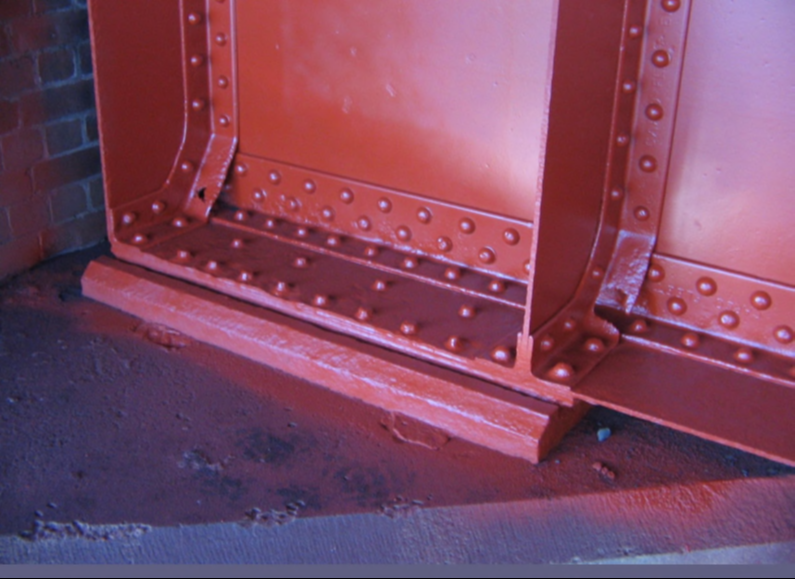
With each type of inspection, data is collected using the CSS Bridge Condition Index criteria and is analysed with a Microsoft Excel database.
The Bridge Condition Index for each bridge is determined from parameters that are gathered during inspections. These parameters are then combined and modified according to the size of the structural elements and their importance in the structure to produce an index for each bridge. These are then combined to produce an index for the entire bridge stock. There is an average index, which covers all elements of a structure, and a critical index that includes only data from the high importance elements of the structure.
Current Condition
The Average Condition Index for those bridges, which have been evaluated using the CSS system is summarised below. This currently accounts for 57% of the bridgestock.
Very Good 30 %
Good 43 %
Fair 26 %
Poor 1 %
Very Poor 0 %
Severe 0 %
Desired Condition
The existing values give a target for maintaining the steady state, although caution must be exercised in making any assumption until several years bridge condition data has been collected and trends established.
Figures in the Best Practice and Optimum columns represent the Council’s first attempt at setting targets and will need to be reviewed over the first 4 years of operation as data is collected.
Average Condition Index for Bridges
|
Level |
Current % |
Steady state % |
Best practice % |
Optimum % |
|---|---|---|---|---|
|
Very good |
30 |
30 |
>97 |
>80 |
|
Good |
43 |
43 |
||
|
Fair |
26 |
26 |
<1 |
<18 |
|
Poor |
1 |
1 |
<1 |
<1 |
|
Very poor |
0 |
0 |
<1 |
<1 |
|
Severe |
0 |
0 |
0 |
0 |
Option Appraisal
Creation/Acquisition
Hartlepool Borough Council acquires responsibility for structures via the following processes:
- Adoption of new structures that are constructed as part of new highways schemes and new developments, e.g. the Marina Way development. HBC typically has input into the design process and such structures become the responsibility of the authority after the expiry of a maintenance period.
- New structures on the Public Rights of Way network become the responsibility of HBC to maintain.
- Structures are from time to time transferred from private ownership to that of HBC. Typical transfers are from the port authority and housing developers and for HBC to accept responsibility for such structures, they must be constructed to appropriate standards. Commuted sums are usually paid to the authority to offset the cost of future maintenance.
Maintenance, Renewal or Replacement and Upgrading
The maintenance treatments for structures may be categorised as:
- Cyclic: e.g. painting, cleaning and the removal of vegetation
- Reactive: e.g. response to vandalism, repairing flood damage or damage resulting from road traffic accidents
- Planned: e.g. replacement of joints and bearings, brick and concrete repairs.
Disposal or Decommissioning
Structures may be decommissioned because they are no longer required
Structures are occasionally disposed of or demolished if their condition has deteriorated to such an extent that they are no longer safe and if the level of usage does not warrant the structure being replaced. Either a stopping up or a diversion of the highway would be required.
Budget Optimisation
Capital
Historically capital funding for structures has been derived from the LTP bidding mechanism. This funding covers major maintenance schemes including re-painting, concrete repairs and replacement of waterproofing/joints. The asset management approach will enable needs based bids for funding to be formulated, via the LTP process.
Revenue
The revenue funding for the maintenance of structures has not been based on condition measures or the demands placed on the network but is a set amount.
The vast majority of this budget is spent on minor remedial maintenance arising from bridge inspections and also includes the in house staff costs for inspections and management of the bridge stock.
Performance Gaps
In the area of highway support, inventory data is weak. There are 22 known retaining walls and the data for these structures is incomplete. In addition there could be a significant number of walls that we don’t know about.
The assessment of bridges using the CSS bridge condition indicator system has commenced but the assessment of the remaining bridges is required to produce a bridge stock condition indicator that can be used as a benchmark for future years.