

Consultation and Engagement
Building on previous consultations in 2019 and 2021, an online consultation was completed to review whether there were any changes in findings. Service users were invited to share their experiences of accessing domestic abuse services. Nonservice users were asked about the barriers that had prevented them using services available.
Background
The online survey, comprising of multiple-choice questions and free text boxes, ran for 8 weeks until the 30th November 2024. It was promoted widely to the public. The survey was included in the Your Say newsletter which was sent out 3 times during the survey period. The survey was also promoted via the Council’s social media feeds and in the local press. Additionally, the survey was directly promoted to service users via Harbour circulating the link to their clients. On this occasion, only the online version was promoted. Paper copies would have been made available on request; however, no such request was received.
The online survey page was viewed by 111 individual people, of which 23 went on to complete the survey. Twenty-five survey responses were received, so 1 or more participants completed the survey more than once. This could potentially have been a support worker completing the form with one or more clients.
Of the 111 people who viewed the project page:
- 42 came direct via the URL shared by email or QR code
- 55 came via the Your Say newsletter email
- 1 came via the Council website
- 3 via search engine
- 24 via social media (23 via Facebook and 1 via X (formerly Twitter))
- 7 via other websites, including the Hartlepool Mail and MSN websites
Demographic information
Of the 25 survey responses:
- Three respondents skipped the demographic questions
- Twenty-one were female and one male
- All said their gender identity was the same as that registered at birth
- Two were 18-24
- 4 were 25-34
- 6 were 53-44
- 5 were 45-54
- 3 were 55-64
- 2 were 65+
- Twenty described their sexual orientation as “heterosexual / straight” and 2 described it as “bisexual”
- Twenty described their ethnicity as “white”, 1 as “black, African, Caribbean, or Black British” and 1 “preferred not to say”
- Ten described their religion as “Christian”, 5 as “no religion”, 4 as “prefer not to say”, 1 as “atheist” and 1 as “Buddhist”
- In terms of whether their day-to-day activities were limited by a health condition or disability:
- 7 were “not limited”
- 5 were “limited a little”
- 8 were “limited a lot”
- 2 “preferred not to say”
- This reflects both the fact that people with disabilities are more likely to experience domestic abuse than the general population and also that Hartlepool has a higher rate of disability and ill health than the England rate
- Two respondents had been in the care of the local authority at some stage, while 19 had not and 1 preferred not to say
- All 22 respondents said they had not been subject to immigration control
- Postcode data has been suppressed due to low response numbers to avoid accidental identification of respondents
Findings
There were 25 survey responses from 111 people who viewed the page. The low conversion rate from viewer to participant can potentially be explained by the challenging subject matter and the difficulties of retelling traumatic stories to answer the questions, so should not be taken as indicating a lack of interest or need in this service area.
As this is a small sample size, it is difficult to draw robust conclusions. However, there are useful details included in the survey comments which provide a level of insight into the lived experience of domestic abuse survivors in Hartlepool.
Of the 25 survey responses, half had used DVA services and half had not.
Of those who had not used support services (the non-user group), all were the current or former partners/spouses of the perpetrator. Similarly, all but one of the people who had used a support service (service user group) were also current or former partners of the perpetrator. In the service user group one respondent was the child of the perpetrator.
The reasons given by the non-user group for not using a support service were “not being aware of anything available locally” (3 respondents), “managing the situation themselves” (3) and “other (please specify)” (4). The “other” reasons given were:
My Mother contacted The Police at the time who where[sic] disinterested and not supportive at all to my situation.
Incident was out of hours and didn't want to involve police as there was no violence but threat and controlling behaviour. I dealt with it myself but could have done with having somewhere for him to sober up and stay overnights as he lives out of town and had no where to go so i had no choice but to let him stay (debated dropping off at local hotel)
I made a phonecall to harbour and the woman on the phone was so rude and snappy with me that it put me off following up.
The non-user group were also asked if they had tried to access a service but it had not worked out, what the reason for this had been. The responses were: “I was turned away” (1 respondent), “services did not seem to be suitable for men” (1), “I did not receive a call-back” (1) and “other (please specify)” (2). The “other” reasons are not very useful (“I’m not a victim of abuse” and “see above”).
Finally, the non-user group were asked what could have been done differently to improve their experience. Three responses were received, as follows:
Understand that the victim has limited choices and sometimes does have to return to the home where abuser is. It's not as simple as NOT wanting to press charges, it can be that they are unable to at that time.
Ensure the staff hired are suitable or give them more appropriate training for the job.
I wish I had known were to go for help it would of [sic] meant I left the relationship earlier.
The service user group were asked how recently they had used the service. Ten respondents had used it within the past 12 months, three within the past 1-3 years and one more than 5 years ago. When asked how many times they had used the service, five had only used it once (not surprising given most had only accessed services recently) the other seven had used it more than 5 times. Unfortunately, the small sample size makes it difficult to draw conclusions from this data, but it is hoped that the respondents who used the service more than 5 times did so because they felt confident in the service they received.
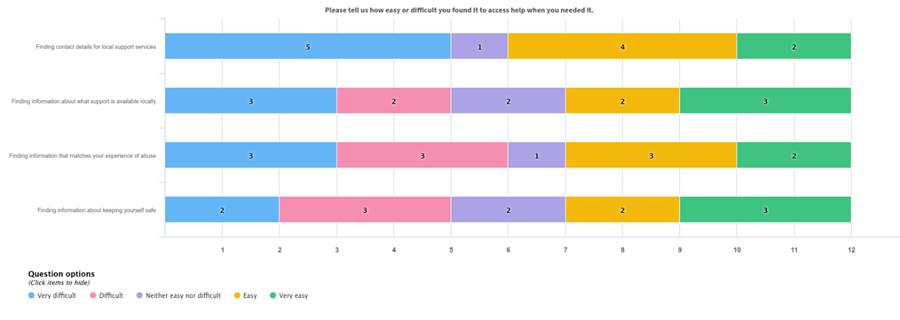
The service user group were asked about how easy or difficult they had found it to find information about local services. The options were “finding contact details for services”, “finding information about support”, “finding information that matches your experience of abuse” and “finding information about keeping yourself safe”.
About half of respondents found each element easy/very easy and half found it difficult/very difficult to access. The breakdown is shown in chart 3 below. Although the sample size is small, it still suggests that more could be done to make information easier to find.
Comments about finding information and support included:
Harbour were fantastic, police were too slow to respond in some events social services were terrible to deal with in regards to protecting my child from domestic abuse.
I suffered every form of domestic/sexual abuse and found myself alone cut off and unable to even speak or receive what was happening to me.
Harbour were useless - long wait lists for counselling and support. Cleveland Police are shameful at handling these cases and got me to drop the case due to insufficient evidence to support my mental health but really it was to save themselves the work. My IDVA and the rape centre in Middlesbrough was amazing.
Services are available but waiting list far too long iv waited over 12 months still not got appointment.
Iv begged for the last few months for help to be told to move on with my life nobody is really interested you get told to phone 111 or samarathons [sic] which don't really help or other on line groups these people aren't supportive of your needs iv.been here twice my first time was ten years ago with my ex husband and agian now with my ex partner
I was referred to social services and given information about the Harbour Domestic abuse services in Hartlepool. Getting in touch with the refuge was very easy and I was able to access help straight away.
Very easy to find the information if you look for it and the posters in healthcare places - getting the help from it is another case.
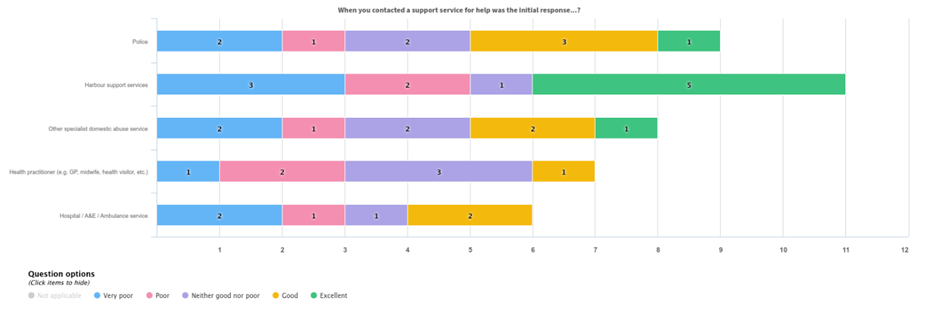
The service user group were asked who they approached for help. The most common response (almost double the number of responses for any other option) was “Harbour”, the second most popular response was “friends or family” and in third was jointly the “police” and “healthcare practitioner”. They were also asked about the initial response each provider made to their approach. Again, it was roughly a fifty-fifty split between poor/very poor and good/excellent. The breakdown is shown below in Chart 2 (note only those options which received a response are included in the chart):
Comments received relating to the initial contact included the following:
Harbour were brilliant very supportive, police did not respond to some incidents as quickly as needed, social services were terrible in communicating, cancelling meetings not turning up for visits etc.
The whole experience was terrible I found myself being misunderstood constantly. I would ask for help by the tie I was contacted back more abuse had taken place and it continued in circles until I had nothing left. (Health, home, family, friends, employment and self respect).
Police not interested the fact your Ben harassed [sic: you are being harassed] by ex partner and family or the fact he already has criminal record for knife crime harbour tell you to move on with your life or put you in s [support] group which involves colouring books in or asking grafts that's not support.
Harbour have been absolutely fantastic in helping me and my young children flee domestic abuse. We would still be with the perpetrator if they hadn’t provided us with shelter and clothed and fed us. I will be eternally grateful to the staff at the Hartlepool refuge. They have saved my children’s future.
Comments relating to other services not listed in the previous question:
Social services were involved but their input was neither supportive or pro active, the would arrange meetings and not turn up or contact myself, did not support myself or my child productively hardly any communication unless Marac meetings were taking place very unprofessional.
I spoke to Samaritans and self referred to my sister place in Middlesbrough. Received therapy but it was stopped and I was told it was by the request of Hartlepool Services. No one contacted me after and I found myself back in the same violent situation and needed to give up work. I then rang local services asking for help or a place in refuge and it took 3 months before I was contacted back.
Although (as already stated) the sample size is small, these responses and comments suggest that initial responses from services can be a bit “hit and miss”; and that where the initial response is not positive, it can cause serious problems for the victim/survivor.
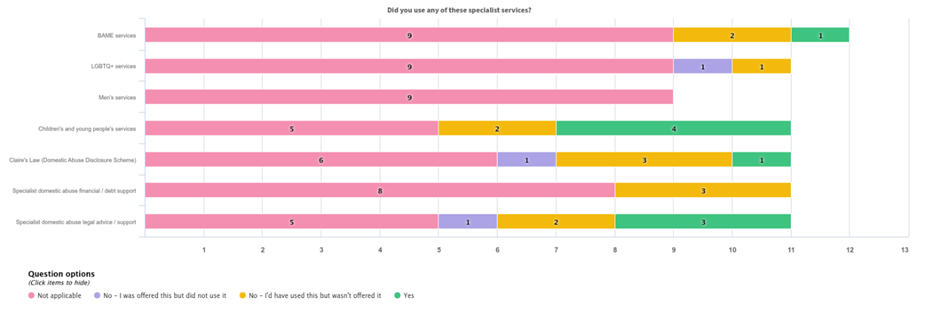
When the service user group were asked about specialist services, only a small proportion of the respondents had used the services on the list. However, for all but one of the specialist services listed several respondents said that they would have used the service if they had been offered it. This suggests there may be a level of unmet need for specialist domestic abuse support services. The fact that no respondents requested men’s services is reflective of the fact that all but one of the survey respondents were female. There may well be more demand from the wider community for specialist men’s services. Chart 3 shows the breakdown of responses. The specialist services listed were:
- BAME services
- LGBTQ+ services
- Men’s services
- Children’s and young people’s services
- Claire’s Law (Domestic Abuse Disclosure Scheme)
- Specialist domestic abuse financial / debt support
- Specialist domestic abuse legal support
When asked to comment on specialist domestic abuse services, respondents said:
To have been supported in line with the law. My Children have both been affected by my situation but never offered help.
Housing support were great with me and really did help me and support me in finding a place to live
Telephone helplines - Childline listened but I felt like they did not understand and kept telling me to go to the police, even though I had already been, and they did not want to do anything. Need a solution for people who are at a dead end.
Refuge accommodation - the safest I ever felt. I could not be found by him, and there was a system in place if he did find us. The only unnerving thing was that workers frequently came into our flat without knocking or notice, which was embarrassing for me as a teenage girl. It would be good if that could change.
Counselling - I used so many of these and had a consistently poor experience…I was terrified of our social worker who had betrayed my trust every time and made it clear that she did not believe me.
When asked if they had needed to move out of their local area to find safe accommodation, the majority of the service user group (7) had not. Of those that had moved, 2 had moved out of Hartlepool to another area, while 3 had moved into Hartlepool from elsewhere.
The service user group were also asked if they had been offered follow up support once their contact with services had ended. Half of respondents (6) had not been offered follow up support but indicated that they would have used it had it been offered. This suggests that where follow up support is available, and appropriate, service users would appreciate being made aware of it. Of the remaining respondents, 3 indicated that they had been offered follow up support and had used it, while 1 was offered follow up support but declined.
Respondents who had used follow up support made the following comments about the service they received:
Emotional support it helped me having someone to speak too who showed understanding and compassion.
Harbour outreach service was invaluable in helping me regain my independence.
I had a worker come out every week to get me into the community, but it was really hard to click with her and I didn't know what I was supposed to do with her. We usually went to get food and eat in her car, but she didn't like this. I was scared to go anywhere with her because I didn't want anyone at school knowing or my family finding me. It didn't really work, but it did get me a break from home which did help.
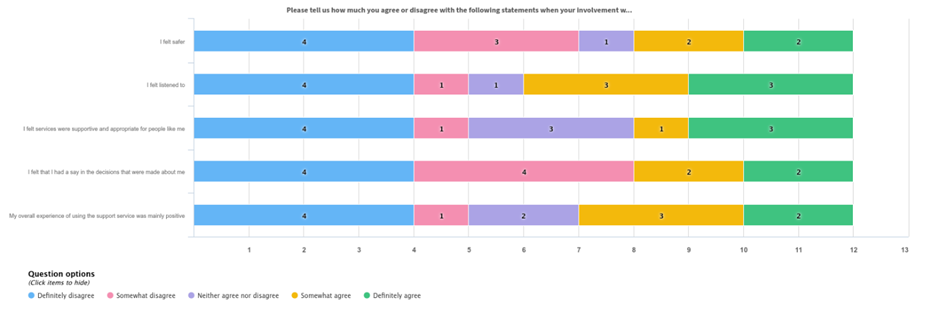
When asked about how they felt when their involvement with services ended, the service user group were again split between positive and negative feelings. The two areas where there were more negative feelings than positive ones were that respondents disagreed that they “felt safer” and also disagreed that they felt they had “a say in decisions made about me”. This is concerning because the purpose of domestic abuse support services is to make the people who use them safe; however, the small sample size could be affecting the result and further investigation into client feedback would be required to find out if this is a significant issue for people leaving services. Chart 4 shows the breakdown of responses. The options were:
- I felt safer
- I felt listened to
- I felt services were supportive and appropriate for people like me
- I felt I had a say in decisions that were made about me
- My overall experience of using the service was positive
The service user group were also asked about their children and any support offered for them. Just over half the group had children (7 compared to 5 who did not). Of those with children, 5 were offered support for their children (of which 3 used the support and 2 declined it). One was not offered any support and the other skipped this question.
Three comments were received about the support offered:
Children's course.
Social services provided terrible support arranging and cancelling meetings, being met with poor attitude and made to feel like a bad person. Harbour were fantastic with myself and my child and provided a lot of support.
Harbour family support worker.
All the respondents who answered the question (3) said it was either “easy” or “very easy” to access the support for their children they had been offered. Two of the three also said that the support had been “good” or “excellent” and one said it was “neither good nor poor”.
Finally, the service user group were asked if they had any further comments to make about their experience of using domestic abuse support services in Hartlepool. The following are a selection of the comments received:
More needed for Men.
No I have not needed services but believe there needs to be more provision for people with pets as in my experience victims are already subject to trauma without having to leave their pets, therefore more likely to remain in an abusive relationship.
I told a housing officer from the council i needed housing as I'd left my partner, implying abuse and because we owned the house they told me to go back until it sold.
Police should respond to all reports of stalking and domestic abuse and not arrange appointments for the following day, social services should be attending planned meetings and not turning up or supporting children included in domestic abuse cases. Harbour were fantastic and provided all the positive support I needed to get a conviction for my abused which saw him sent to prison and given a restraining order.
The 6 months wait time for eligibility for local welfare support is crippling families that are subject to DA.
I had a girl called Nicola she supported and valued my options,, I will be forever grateful for her time and compassion.. it is so scary when you are living in a abusive relationship and feel you have no one.
Harbour refuge at Hartlepool was absolutely amazing. We arrived with nothing and they clothed and fed myself and my two young children and looked after us until we were able to leave and move into a property of our own. They definitely need more resources as they rely heavily on donations. With a little funding they could work miracles. They saved our lives.
I didn’t know the service was available to everyone. I always thought that the services were only for physical abuse. I have encountered verbal abuse and economic abuse and coercion. I recently had verbal abuse and was made to feel that I was the one with the problem because it was only meant as a joke. Even though it was offensive, derogatory and at the time the situation was frightening. Sadly the effect of husband drinking alcohol. I become the target.
Believe what the children say. My life was immeasurably changed and somewhat ruined by the treatment I received by police, social workers, medical professionals. Also you cannot lump together Harbour and the police for instance. I could not have had a worse experience with the police but Harbour was fantastic and I will always support their work. However, I am terrified of the police…
Conclusions
Unfortunately, the small sample size means that it is difficult to draw meaningful conclusions from the survey data. However, some common threads are apparent such as that early intervention and preventative help would have greatly benefited some respondents. Understanding, empathy and listening to victims were also highlighted as being key things people would like to see from services.
Additionally, the response that people receive when they first contact services is crucial as to whether they go on to access and have a good relationship with that service. Also, where people are made aware of follow up support that is available, they often go on to use this support. These are points that services may like to consider going forward.
The fact that over half of the respondents had some kind of limiting health condition or disability is very important. Consideration should be given as to how domestic abuse services can be made more accessible to people with disabilities (tying in with ongoing work across the Council in light of the recommendations of the Scrutiny Committee investigation into improving disabled access to all our services).
Additionally, Harbour service users are also encouraged to access the recovery service once formal support has ended and contribute to the Service User Panel to inform strategic decisions.
Strategic issues arising from consultation
The following strategic issues were identified from the consultation. They have been considered in the overall findings and are represented in the final strategic issues outlined in section 6 (Strategic Issues).
- People with disabilities are more likely to experience domestic abuse than the general population and Hartlepool has a higher rate of disability and ill health than the England rate. 59% of the survey respondents reported a limited health conditions or disability.
- Services need to be visible and accessible. There needs to be further education and awareness raising to reduce the stigma of domestic abuse and break down barriers. Some respondents in the survey stated they “were not aware of anything locally” or were “managing the situation themselves”.
- Services need to be trauma informed and use professional curiosity, including in cases where service users decline to engage. Training should be provided to multi-agency practitioners in recognising and responding to domestic abuse and ensure that practitioners are aware of the many forms of domestic abuse and the definition of ‘personally connected’ covering intimate partners and family members. One respondent highlighted “staff should have more appropriate training”.