

Data and Intelligence
National Prevalence and Trends
The prevalence of domestic abuse nationally is difficult to estimate as it is very often a hidden crime, which means that under-reporting of offences is an issue when looking at data.
There has been a gradual decrease in domestic abuse over the last 10 years. The CSEW for YE March 2024 estimated that 5.4% of people aged 16 to 59 years experienced domestic abuse in the last year compared with 6.5% in YE March 2014.[i]
Locally there has been a slight increase in the proportion of adults aged 16-74 who are experiencing domestic abuse and is around half of the proportion nationally. This can be attributed to the fact that the national data is taken from the CSEW which includes crimes which are not reported to the police, whereas the local data is purely based on police reports.
|
Metric |
2019/2020 |
2023/2024 |
|
Adults aged 16-74 who experienced domestic abuse in the past 12 months |
2.1%
|
2.6% |
|
Females aged 16-74 who experienced domestic abuse in the past 12 months |
3.1%
|
3.6% |
|
Males aged 16-74 who experienced domestic abuse in the past 12 |
1.0%
|
1.6% |
|
Domestic abuse crimes |
2019/2020 |
2023/2024 |
|
Total number of domestic abuse incidents and crimes |
3,370
|
3,146 |
|
Proportion of domestic abuse incidents not subsequently recorded as a crime |
38%
|
33% |
|
Proportion of domestic abuse incidents recorded as a crime |
62%
|
67% |
|
Proportion of domestic abuse incidents recorded as a crime – % change from 2019/20 to 2023/2024 |
|
+8% |
Rates of domestic abuse per head of population remains difficult to calculate due to factors such as under-reporting and frequent changes in how this data is recorded and classified over time. However, Department of Health & Social Care have produced a crude rate based on the number of recorded domestic abuse incidents and crimes per 1,000 population.
This gives Hartlepool a rate of 43.2 domestic abuse incidents and crimes per 1,000 population in 2023/24. This is an increase of 3.2 since 2019/2020. However, it is worth noting this is based on the Cleveland Police force area. Nationally, the rate has decreased by 0.9.[i]
Crime Data
For the period October 2022 to September 2023 there was an increase of 3% of police recorded incidents of domestic violence and a 12% increase of domestic related violent crimes compared to the previous year October 2021 to September 2022. Domestic violence crimes are 21% of all recorded victim-based crime in Hartlepool, 76% of which are violence offences.
Women and girls in Hartlepool continue to be at the greatest risk of domestic violence and abuse with 70% of all victims being female. 62% of female victims of domestic violence and abuse are aged between 21 and 42 years. Repeat victimisation is evident, with 34% of female victims and 22% of males suffering two or more incidents during the reporting period.
In relation to the perpetrators charged with domestic abuse offences during the assessment period, 84% were males with more than two thirds aged between 27 and 45 years. Repeat offending is evident with 41 males charged with 2 or more offences during the reporting period.[ii]
Hartlepool, along with Stockton, Middlesbrough and Redcar and Cleveland are part of the Cleveland Police force area. Data provided by the ONS for the Cleveland Force for the year ending March 2024:[i]
Domestic Abuse-Related Crimes
- 20,218 domestic abuse related incidents and crimes were recorded – equivalent to 35 incidents per 1,000 population. This is a 10.64% increase from 2024.
- Cleveland Police have the second highest rate of domestic abuse incidents per 1,000 population of all 43 police forces.
- 13,943 domestic abuse related crimes were recorded – equivalent to 24 crimes per 1,000 population.
- Cleveland Police have the highest rate of domestic abuse related crimes per 1,000 population of all 43 police forces.
18% of all recorded crimes were classified as domestic abuse-related compared to 16% for England and Wales which is a 1% increase for both, since 2020.
Arrests, Charge Rate and Prosecutions
- In 2024, there were 35 arrests per 100 domestic abuse-related crimes in Cleveland; lower than the England and Wales rate of 42 arrests per 100 domestic abuse-related crimes.
- The charge rate for domestic abuse-related offences was 73% in Cleveland (equating to 910 domestic abuse-related charges). This is lower than the charge rate for England and Wales which was 79%. Note: CPS amended the method for reporting the charging rate in 2019 to exclude non-legal decisions. Data on the charging rate included in previous publications may not be comparable to data in this publication.
- 981 domestic abuse-related prosecutions took place – equivalent to 15% of all prosecutions in Cleveland, and up from 13% in 2020. The England and Wales rate fell from 14% in 2020 to 12% in 2024.
- 747 domestic abuse-related convictions were recorded in Cleveland – this means that 76% of domestic abuse-prosecutions resulted in conviction (a fall of 3% since 2020); this is the same as the rate of prosecution in England and Wales.
Clare’s Law
Data for Hartlepool shows that there has been an increase in the number of Clare’s Law application, both right to ask and right to know. However, there has been a decrease in the percentage resulting in a disclosure.
|
Applications |
2022/2023 |
2023/2024 |
|
Right to Ask applications |
133 |
170 |
|
Right to know applications |
225 |
272 |
|
Total |
358 |
442 |
|
Disclosures |
2022/2023 |
2023/2024 |
|
Right to Ask disclosures |
61 |
61 |
|
Right to know disclosures |
100 |
77 |
|
% resulting in a disclosure |
45% |
31% |
Harbour Client Data
Harbour is the only commissioned domestic abuse support service within Hartlepool. This includes providing safe accommodation, outreach and targeted support programmes.
Harbour data shows that both overall referrals and individuals referred for support have decreased by 4-5% from 2022/23 to 2023/24 as shown in the table below. Repeat referrals also declined in both number and proportion in 2023/24, down from 13.1% to 10.5%.
|
Origin of referral |
2022/23 |
2023/24 |
|
Referrals |
3296 |
3165 |
|
Individuals referred |
2372 |
2266 |
|
Repeat |
310 |
239 |
In 2023/24, less than 50% of referrals to Harbour services came from the police, down from 52.3% in the previous year. Self-referrals, referrals from social services (both child safeguarding and early help) and MARAC all increased their proportion of referrals in 2023/24 and accounted for 35.2% of referrals in 2023/24. In contrast, 4% of referrals were made by health services (GPs, community midwives, hospital, health visitors and mental health services). More than half of the health service referrals came from mental health services, and no referrals came from community midwives or health visitors.
Clients with Children
Clients with children in 2023/24 was roughly four in five have children, compared with 2 in 3 in 2022/23. In both years roughly a third had child protection needs, but in 2023/24 a third had child in need, compared with only 1 in 10 in 2022/23.
|
Clients Assessed |
2022/23 |
2023/24 |
|
% clients with children |
66% |
82% |
|
% clients with children engaged with Early Help |
0% |
5% |
|
% clients with children subject to Child Protection |
34% |
29% |
|
% clients with children subject to Child in Need |
11% |
31% |
|
% clients with children in Looked After Care |
10% |
9% |
Adult Social Care
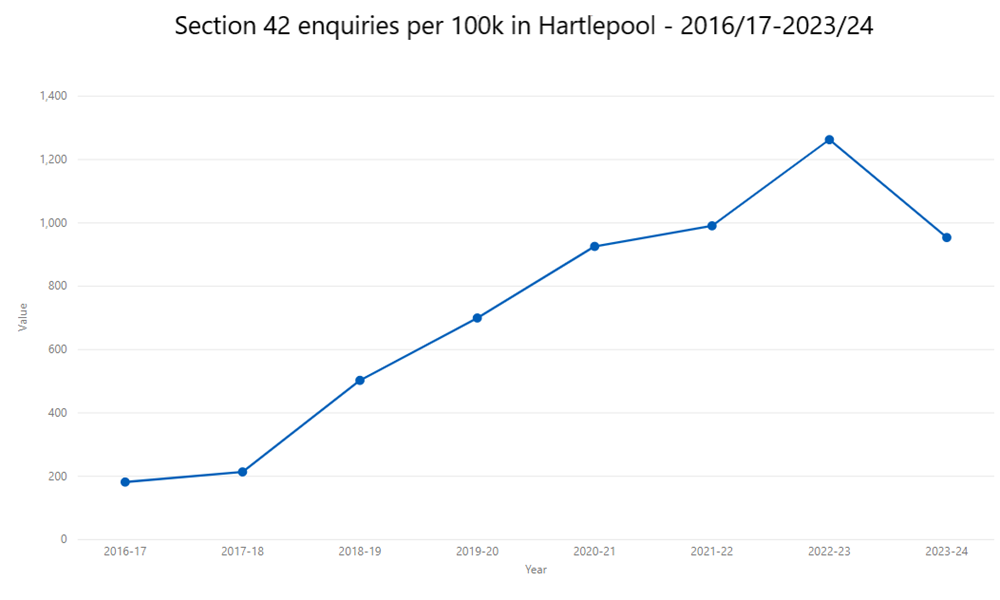
The rate of Section 42 adult safeguarding enquiries in Hartlepool is 952 per 100k, this is almost 2.5 times the size of the England rate of 390 per 100k.
Hartlepool’s rate of 952 per 100k is the 4th highest in the north east, and is comparable to Darlington and North Tyneside, the next two largest rates. Hartlepool’s 2023/24 rate is lower than the 2022/23 rate and ends a run of five consecutive years of increase. The 2023/24 rate is almost 25% lower than the previous year.
The proportion of Hartlepool’s section 42 enquiries relating to domestic abuse is at its highest level since 2020/21.
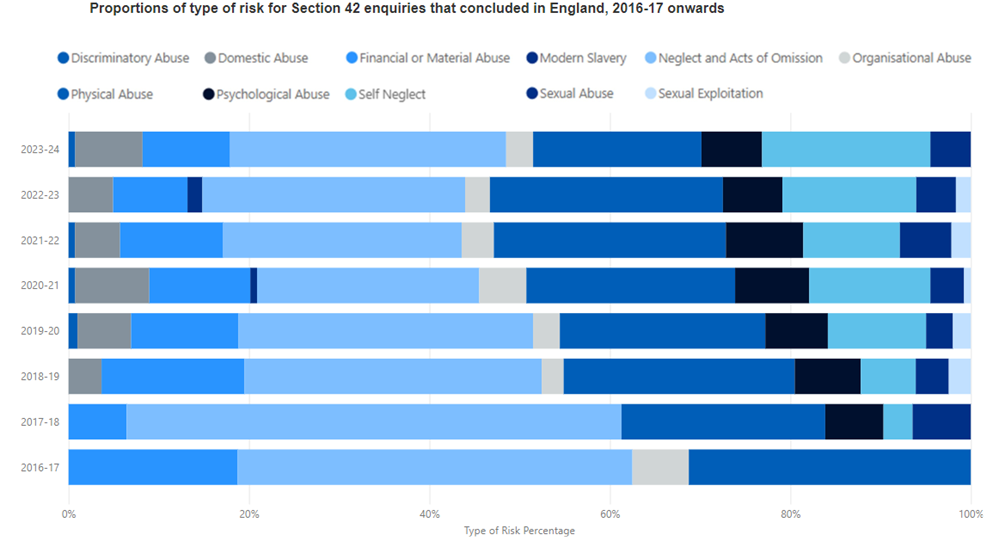
The rate in 2020/21 of 8.21% is the only year in the eight-year reporting period where it is higher than the 2023/24 rate. 2023/24 ended a two-year reduction in the proportion relating to domestic abuse.
It is recognised that the type of abuse recorded from an adult safeguarding referral, is that which the referring agency deems the most suitable. This means that domestic abuse is likely to be under-recorded where there is more than one type of abuse being perpetrated towards an individual, or a professional is recording based on the type of abuse eg) physical or financial. As of April 2025, sub-categories have been introduced for domestic abuse.
The below table shows the number of adult safeguarding concerns and section 42 enquiries during the period 1st April 2023 – 31st March 2024.
|
Quarter & Year (Fiscal) |
Concerns |
S42 Enquiries |
|
Q1 2023/24 |
450 |
196 |
|
Q2 2023/24 |
503 |
218 |
|
Q3 2023/24 |
451 |
159 |
|
Q4 2023/24 |
457 |
166 |
|
Total |
1861 |
739 |
Of these, referrals, 105 concerns were identified by the referrer as domestic abuse, 11 of which were a repeat referral within the previous 12 month period.
Homelessness
Data provided by the council’s housing advice team shows that from the period April 2018 to September 2020 that was previously provided, the number of households presenting due to domestic violence and abuse is increasing as shown up to March 2023. The increase shown in the year 2022-2023 could be following the introduction of the Domestic Abuse Act and the updated guidance on responding to domestic abuse in homelessness. It is also worth considering the impact post-covid may have had on presentations.
A relief or prevention duty was accepted in most cases. In the two cases where a duty was not accepted, one had advice or guidance given and the other household withdrew their application.
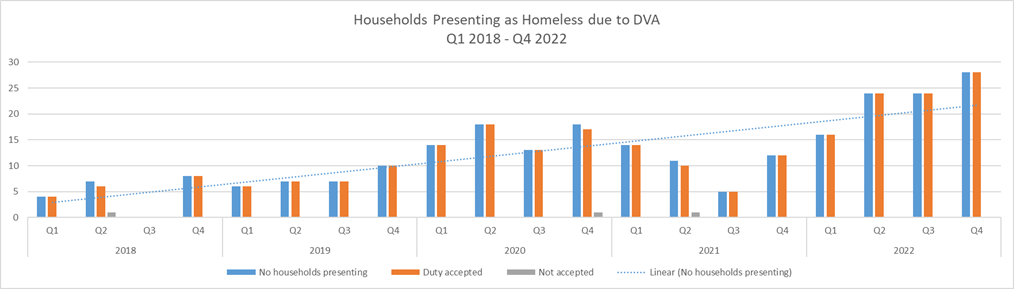
In terms of gender, most individuals presenting as homeless are female (211). In September 2020, 84% of the individuals were female. However as of March 2023 this has increased to 95%. The number of males presenting is the same (11).